
SaaS inflation rate
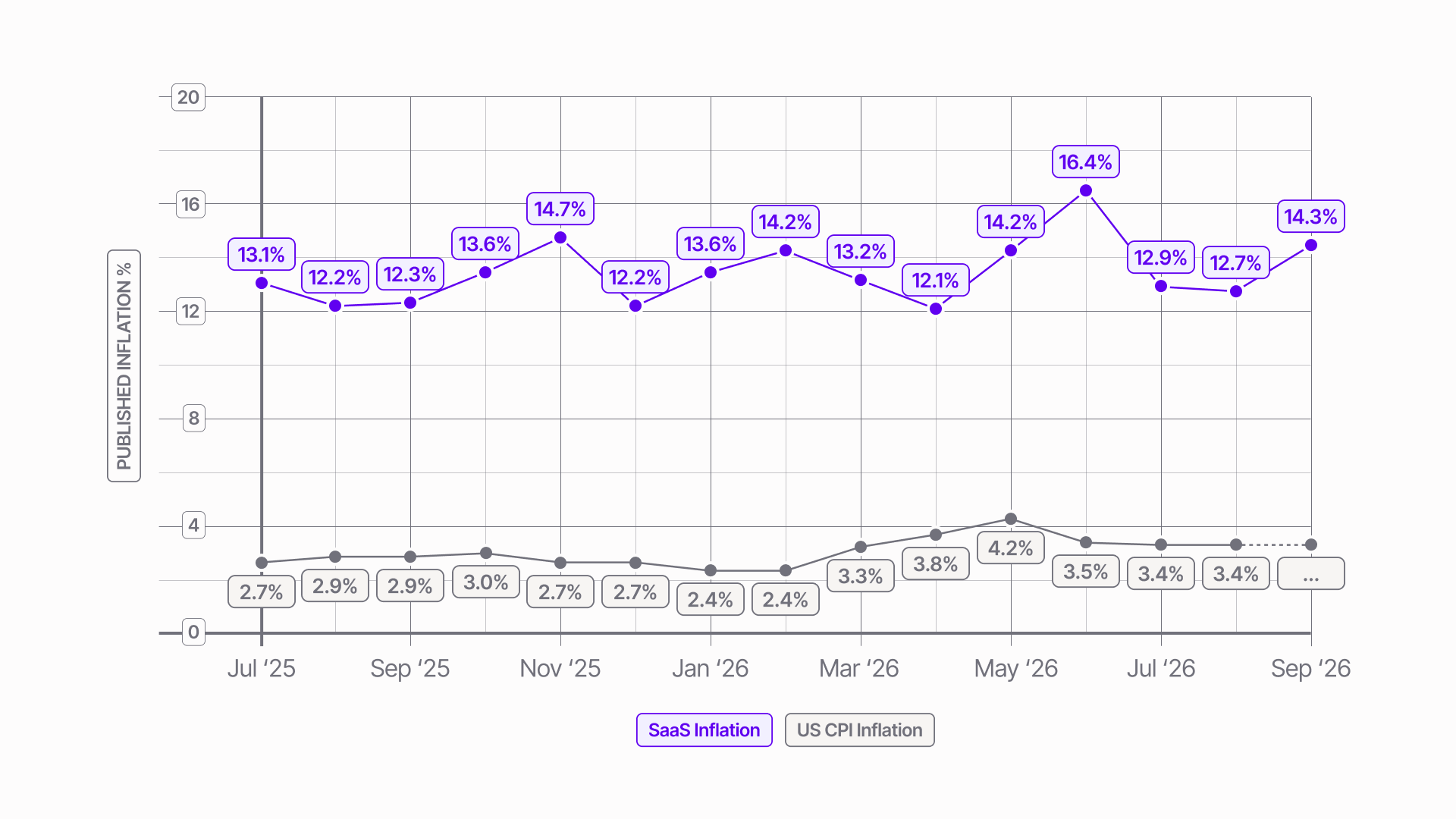

How much are software prices rising in 2026?
While general inflation in many economies has stabilized, Vertice's data shows that software vendors are continuing to implement double-digit price increases.
After reaching a record high of 16.4% in June 2026, SaaS inflation cooled in July to 12.9% and eased slightly further to 12.7% in August. Early data for September suggests prices are picking back up, with inflation rising to 14.3%. That is higher than both July and August, but still below June's peak.
- A mid-year cooling: SaaS inflation fell 3.5 percentage points between June and July. This reversed much of the rapid climb seen in Q2, when rates rose 4.3 points in just two months. August's 12.7% was the lowest monthly rate since April.
- Signs of a rebound: September's partial data points to renewed upward pressure, with inflation up 1.6 points from August. Even at the lowest point in Q3, rates stayed above 12%, confirming that double-digit increases remain the norm rather than the exception. SaaS shrinkflation may be adding to the real cost, as vendors combine list-price increases with reduced feature access at the same tier.
- Renewal timing matters: For companies on annual contracts, these month-to-month swings don't change what they're already paying. However, they do mean the increase they're offered at renewal depends heavily on timing. A renewal quoted in June faced a market rate nearly 4 points higher than one quoted in August. Without visibility into how rates move across the year, there's no way to know if a renewal quote is high, low or in line with the market.
Real-time pricing benchmarks are the most effective way to manage this volatility, giving finance and procurement teams visibility into current market rates before a renewal locks in a higher-than-necessary increase. An AI procurement platform like Vertice flags when a quoted increase is out of line with what similar companies are actually paying. Companies using this kind of industry-leading pricing intelligence achieve an average discount of 32.8% compared to list price.
Data source: These insights are derived from over $75bn of global processed spend managed by Vertice in 2026. Q3 2026 figures are preliminary and based on data processed to date.
Are you overpaying for SaaS?
Are you overpaying for SaaS?
Related materials


Related insights
Join the community

The need-to-knows about Vertice
Based on early data for September 2026, SaaS inflation stands at 14.3%, up from 12.7% in August but below June's record high of 16.4%.
It cooled mid-year and is now picking back up. After peaking at 16.4% in June 2026, SaaS inflation fell to 12.9% in July and 12.7% in August, the lowest monthly rate since April. Early September data shows it rising again to 14.3%. Even at its lowest point in Q3, it stayed above 12%, so double-digit increases remain the norm.
Real-time pricing benchmarks help finance and procurement teams see current market rates before a renewal locks in a higher-than-necessary increase. This matters more as rates swing month to month: a renewal quoted in June 2026 faced a market rate nearly 4 points higher than one quoted in August. Companies using a platform like Vertice that provides a high level of pricing intelligence achieve an average discount of 32.8% compared to list price. It also helps pinpoint where waste exists across the SaaS stack and where spend can be optimized.
With inflation swinging between 12.7% and 16.4% in the space of three months, static annual budgets are increasingly likely to fall short by renewal time. Budget management tools help finance teams track software spend against forecasts in real time and adjust allocations as pricing trends shift, rather than discovering the gap at renewal. Pairing this with SaaS spend management software gives a fuller picture of where rising costs are concentrated across the software portfolio, so budgets can be reallocated toward the categories most exposed to inflation.