
See how simple procurement can be

Contract Management in Procurement: The Contract Lifecycle, Process and CLM Tools
Contract management in procurement covers how organizations create, store, negotiate and track supplier agreements through their full lifecycle – from key terms and pricing to renewal dates and compliance obligations. The average organization now uses 144 software applications, each requiring roughly 12 days to negotiate, making a centralized, automated approach essential rather than optional.
What is contract management in procurement?
Contract management in procurement is the process of overseeing and administering contracts across their full lifecycle, from the initial purchase request and negotiation through execution, compliance monitoring, invoice matching and renewal, so that both the buyer and supplier deliver on what was agreed.
Below, we cover why contract management plays such a crucial role in the overall procurement process, the key stages and best practices, and where AI and outsourced procurement expertise fits in.
The importance of contract management in procurement
Contract management directly affects cost control, supplier performance and risk. Yet tracking renewals, obligations and performance across hundreds of suppliers (software, services, marketing, facilities, hardware) is difficult to do manually.
Pricing pressure makes it harder still. SaaS prices are rising at several times the rate of general inflation and more vendors are moving to usage-based pricing that's far harder to forecast. Vertice's 2026 data shows consumption-based models average a 37.6% average monthly budget variance, with it taking less than six months for contracts to drift by more than 15%.

Without a structured, automated approach, procurement teams miss renewal dates and termination windows, lose track of obligations and go into renegotiations without the leverage needed to rightsize contracts and reduce costs.
Key components of contract management in procurement
For procurement to effectively manage contracts, there are a number of key components that must be addressed throughout the entire lifecycle of a contract.
These components ultimately ensure that agreements are optimized, risks are mitigated and supplier relationships are maximized.
Contract creation and negotiation
Successful contract management starts with a well-negotiated agreement that aligns with organisational goals, delivers value and is legally sound. Strong negotiation means:
- Ensuring fair pricing – Benchmarking data shows what similar companies pay for the same product or service, giving you the leverage to push back on quotes. Vertice's benchmarks draw on 2M+ pricing points from 250,000+ contracts. For strategic suppliers, Vertice's procurement experts can lead SaaS contract negotiations; for tail spend, Vertice's autonomous negotiation agent, Ana, negotiates smaller contracts that would otherwise go unchallenged. Data shows that 70% of these tail spend contracts renew without review.
- Defining clear deliverables and performance standards – It’s important to establish measurable criteria for quality, service levels and uptime guarantees, data security and privacy standards, customer support response times, and timelines to ensure that both parties fulfill their commitments.
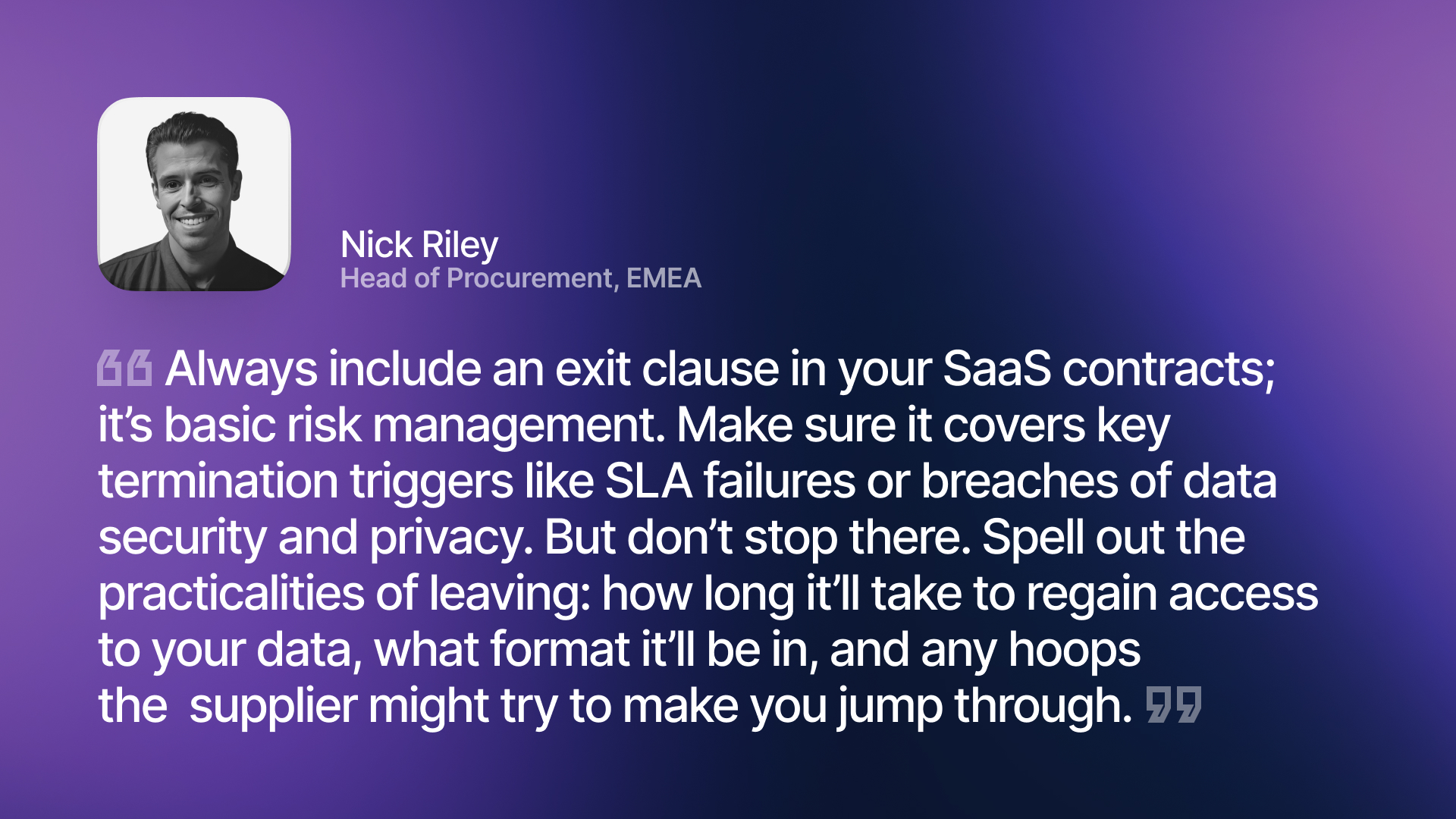
- Incorporating risk mitigation – Include clear SLAs, confidentiality and data protection provisions, dispute resolution mechanisms and an exit clause specifying when the contract can be terminated early.
- Aligning with long-term objectives – Build in room for growth without full renegotiation, such as pre-agreed rates for additional users or usage. For usage-based contracts, negotiate overage caps and alerts so costs can't drift unchecked.
Execution and implementation
Once signed, contract terms need to be put into practice. This means coordinating deliverables, timelines and obligations, setting KPIs, monitoring service levels and keeping internal and external stakeholders aligned. AI can now extract key dates, obligations and pricing from the signed contract automatically.
Compliance monitoring
The compliance monitoring stage is essential for ensuring that both parties adhere to the terms and conditions outlined in the contract. This stage specifically involves regularly tracking the performance of the contract to ensure that all obligations – such as service levels, deadlines, and quality standards – are being met. It should also extend to what you're billed: matching supplier invoices against agreed contract terms ensures that what was agreed is what gets paid, catching pricing errors and unapproved charges before invoices are approved for payment.
By maintaining a strong compliance monitoring process, organizations can reduce the likelihood of disputes, avoid penalties, and ensure the contract continues to align with the company's strategic objectives and regulatory requirements.
Renewal or termination
Auto-renewal clauses are standard in many supplier contracts, so track both renewal dates and termination windows (the notice period required to change or exit a contract), leaving enough time to decide whether to:
- Renew on the same terms
- Rightsize based on usage data
- Consolidate with another supplier
- Terminate the contract
expiBenchmarking data is especially valuable here, given how quickly supplier prices are rising – 14.3% a year according to Vertice's inflation data. Timing matters too. Vertice's 2026 renewal data shows organizations that start negotiating 120+ days before a contract expires save 12.1% more on average than those who wait until the final month, giving them time to benchmark, negotiate and walk away from a bad offer, preventing vendor lock-in.

Best practices for effective contract management
Centralize your contract repository
A single repository for every contract, capturing terms, pricing tiers, usage limits and renewal dates, enables fast retrieval and reduces the risk of missing key obligations.
Create audit trails
Contract management software logs every change and version, showing who changed what and when. This prevents outdated terms from being used and reduces the risk of disputes.
Enable collaboration and workflow automation
In many companies, contract management involves multiple stakeholders from various departments, such as legal, finance, procurement and IT. When reviews happen sequentially, each team waits for the last to finish and a single delay holds up the whole contract.
Automated workflows route contracts to the right reviewers at the right time, running independent reviews such as legal and security in parallel and keeping sequential approvals only where one decision depends on another. That removes bottlenecks, shortens cycle times and ensures nothing falls through the cracks.
Use AI to review contracts
AI can summarize long agreements, extract key terms and flag clauses that breach your internal compliance standards, cutting manual review tie for legal and procurement teams.
Connect contracts to budgets and payments
When contracts, budgets and invoices sit on the same record, finance can see committed spend against budget in real time, and payments are checked against what was negotiated.
Make use of data-driven insights
Data-driven insights are a powerful tool during contract negotiations and renewals, enabling procurement teams to make more informed decisions for optimizing costs and driving efficiency.
By analyzing usage rates and pricing trends, teams can specifically identify opportunities for cost savings and negotiate more favorable terms. Data can also be used at the point of renewal, helping to determine whether a contract should be renewed, rightsized, consolidated, or even terminated.
Outsourcing contract management: When and how to leverage external procurement expertise
As supplier bases grow, managing every contract effectively becomes difficult without external support. Signs you may need it include struggling to secure the best price on every deal, tail spend that's growing harder to manage, or too much time lost to meetings just to keep renewals and purchases on track. Outsourced procurement providers can:
- Extend your team on demand – Support for a single negotiation, a specific initiative or your entire procurement function, adding capacity without replacing your internal team.
- Negotiate on your behalf – Outsourced procurement providers not only have access to unparalleled leverage in the form of pricing benchmarks, they also have extensive vendor knowledge that allow them to secure far better pricing and deals on any deal. Cost savings aside, external procurement companies can also deliver substantial time savings, enabling you to focus your efforts on more strategic procurement initiatives.
- Run sourcing events – Managing RFIs to gather market intelligence before you commit, RFQs for price-led sourcing and RFPs for competitive, solution-led sourcing.
- Recommend the right suppliers – Expert-led market analysis to identify leading suppliers in any category and inform your sourcing strategy.
- Consolidate and rationalize – Assessing your existing tools and suppliers to eliminate duplicated functionality and reduce supplier count.
- Benchmark against peers – Comparing your technology portfolio and procurement processes with industry peers to sharpen investment strategy and improve operational efficiency.
- Support budget planning – Hands-on support through the annual budgeting cycle to improve forecasting accuracy.
- Cover tail spend – Applying negotiation support and automated workflows to lower-value contracts so they're held to the same benchmarking and compliance standards as strategic ones, freeing your team for high-value supplier relationships.
- Ensure compliance and mitigate risks – Managing contract compliance becomes easier when experts are involved. They help identify and mitigate potential risks, ensuring that all contracts are compliant with relevant regulations and company policies.
- Identify cost-saving opportunities – Procurement providers excel at uncovering cost-saving opportunities across your tech stack, including within your tail spend. By gaining visibility into all areas of procurement, they can identify and address areas where savings can be achieved.
- Provide visibility – Procurement outsourcing ensures transparency across the entire procurement process, offering insights that empower you to make data-driven decisions, optimize spending and track performance.
Vertice covers the full contract lifecycle on one platform, from intake and negotiation to vendor management, contract management and procure-to-pay, and is the #1 Leader in procurement orchestration on G2's Fall 2026 Grids for both mid-market and enterprise organizations. See Vertice in action by taking an interactive tour of the platform.
Contract Management in Procurement
FAQs
The contract management process usually runs through six stages: request and planning, drafting from approved templates, negotiation, execution, performance monitoring against agreed service levels and KPIs, and renewal or termination. Each stage feeds the next across the contract lifecycle, so the terms agreed during drafting decide what can be tracked and enforced later.
Contract management is the day-to-day work of drafting, approving and overseeing supplier agreements. Contract lifecycle management (CLM) software is the technology that supports it, with a central repository, approval workflows, automated alerts for renewal dates and a full audit trail. Vertice provides these capabilities for SaaS and software contracts, and connects to standalone CLM tools for teams that already use one.
It is shared. Procurement leads sourcing, negotiation and the supplier relationship, legal reviews risk and compliance language, and finance checks that budgets, invoices and payment terms match what was agreed. Business owners oversee day-to-day delivery. Procurement contract management works best when all four teams work from the same contract record and approval workflows.
Agree measurable KPIs and service levels in the contract, then review them on a set schedule, more often for critical suppliers. Supplier scorecards that combine delivery, quality, spend and usage data make performance monitoring objective and give procurement evidence for the renewal or termination decision. For software contracts, Vertice adds usage analytics, so teams can see whether licenses are actually being used.
AI can read contracts and extract key dates, obligations and pricing, flag clauses that differ from your standard templates, and summarize long agreements for legal and finance teams. Vertice AI is trained to complete 70+ procurement tasks, including compliance and legal checks within workflows, so teams spend less time on manual review and more time on negotiation and supplier strategy. For tail spend contract, Vertice's autonomous negotiation agent, Ana, negotiates directly with suppliers on your behalf, capturing savings on the smaller agreements procurement teams rarely have time to review.